

You just landed your first contract as a self-employed worker. Congratulations! One step remains that nobody ever taught you: sending your first invoice. What must it contain to be legal and professional? When should you send it? What payment terms should you require? Here is the beginner’s guide to invoicing your first clients in Quebec — stress-free and mistake-free.
What an invoice must contain
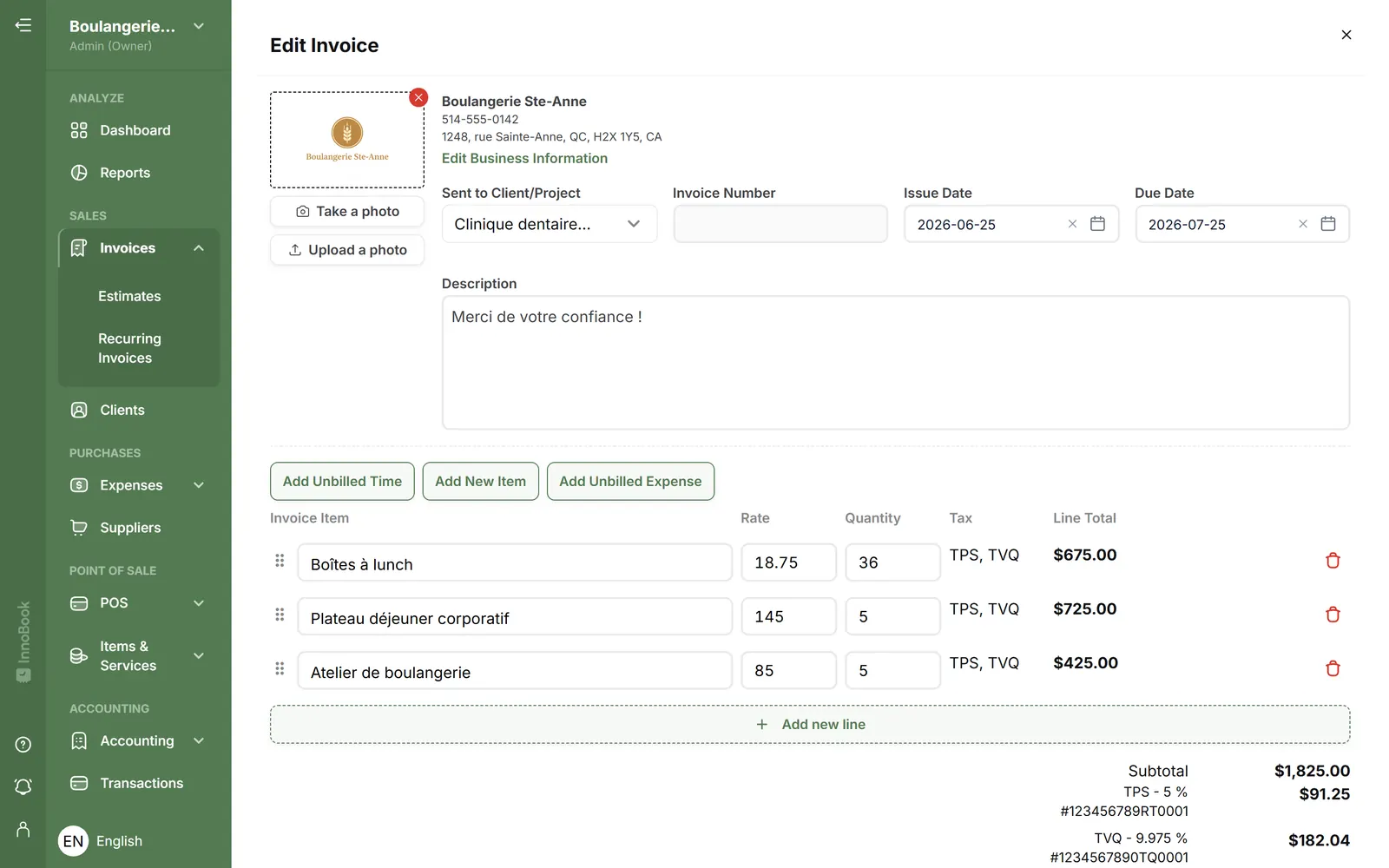
A proper invoice in Quebec should always include:
- Your complete contact information: name (or registered business name), address, phone, email;
- The client’s contact information;
- A unique, sequential invoice number;
- The issue date and the due date;
- A clear description of the goods sold or services rendered (quantities, hourly rate or flat fee);
- The amounts: subtotal, GST and QST shown separately, total;
- Your GST and QST registration numbers — mandatory on the invoice as soon as you are registered and charging taxes;
- Payment terms: deadline, accepted methods, late fees if applicable.
Important: if you are not registered for GST/QST (small supplier under $30,000), do not charge any tax. Charging taxes without being registered is illegal. To know when and how to register, read our GST and QST guide for self-employed workers.
When should you send the invoice?
The rule is simple: as soon as possible. The day the work is delivered, ideally. Every day between finishing the mandate and sending the invoice is a free extension you are giving your client. For longer projects, don’t wait until the end:
- Milestone billing: a percentage at signature, another at the halfway point, the balance on delivery;
- Recurring billing: for monthly retainers, invoice on a fixed date every month;
- Initial deposit: for a brand-new client, asking for 25–50% upfront is common practice and perfectly professional.
Which payment terms should you choose?
“Net 30” is a habit inherited from big corporations — not an obligation. For a self-employed worker, net 15 or even due on receipt is entirely acceptable, especially for small amounts. Also spell out:
- the accepted payment methods: Interac transfer, direct deposit, credit card — the easier it is to pay, the faster you get paid;
- reasonable late fees (for example 1.5% per month, 18% per year) — stated on the invoice and in your quote;
- your deposit policy for new clients.
Numbering: simple, but no gaps
Pick a format and stick to it: 2026-001, INV-0001, whatever you like. What matters: numbers that are unique, sequential and without duplicates — that is what the CRA and Revenu Québec expect to see in an audit. Invoicing software handles numbering automatically and eliminates human error.
The 4 habits of professional billers
- Confirm the mandate in writing before starting — an accepted quote prevents 90% of billing disputes;
- Itemize your work — a single line reading “Services rendered: $2,500” invites negotiation; clear detail builds trust;
- Track your receivables — know at all times who owes you what, and since when;
- Follow up without embarrassment — a polite reminder on the due date, a second at +7 days, a phone call at +14. It is your money.
And above all, avoid the classic traps we covered in 5 invoicing mistakes that cost freelancers money.
Invoicing with InnoBooks: ready in 5 minutes
You can build invoices in a spreadsheet… until the first tax or numbering mistake. InnoBooks was designed for Quebec’s self-employed workers:
- ✅ Professional invoices with your logo, in French or English;
- ✅ GST and QST calculated automatically, tax numbers displayed correctly;
- ✅ Automatic numbering with no gaps or duplicates;
- ✅ Quotes converted to invoices in one click;
- ✅ Receivables tracking: paid, pending and overdue invoices at a glance;
- ✅ Online payment so you get paid faster.
Frequently asked questions about invoicing
Do I need to register a business to invoice?
If you operate under your own name (first + last name), no registration is required in Quebec. As soon as you use a business name that differs from your own, you must register it with the Registraire des entreprises du Québec (REQ).
Can I invoice without GST/QST numbers?
Yes, as long as you are a small supplier (under $30,000 in gross revenue over four consecutive quarters). In that case you charge no tax and display no numbers. Once registered, the numbers become mandatory on your invoices.
Is an emailed invoice valid?
Absolutely. A PDF sent by email is the norm today. Keep a copy of every invoice you issue — like all your supporting documents — for six years.
My client refuses to pay. What are my options?
Start with written reminders, then a formal demand letter. For amounts of $15,000 or less, the Small Claims Division of the Court of Québec is accessible without a lawyer. A signed quote and clear invoices are your best evidence.
Bottom line
Invoicing is more than asking for money: it is an extension of your professional image. Complete information, accurate taxes, rigorous numbering, clear terms and prompt sending — with those five elements, your first invoices will be as solid as your work.
Ready to send a flawless first invoice? Try InnoBooks for free and invoice like a pro from client number one.