

The quote is the most profitable document in your business: it is what turns a prospect into a client, sets the price, and protects you when a project goes sideways. Yet many self-employed workers dash it off in two lines of an email. Here is how to write quotes and estimates that convert — and that spare you the bad surprises.
Estimate vs quote: which does what?
- An estimate gives a non-binding ballpark: “this type of project usually lands between $4,000 and $6,000”. Useful for qualifying a prospect early.
- A quote is a firm offer: defined scope, precise price, terms, validity period. Once accepted, it binds you both.
Golden rule: never start work without a quote accepted in writing. In Quebec, a verbal contract is valid… but in small claims court, it is your word against theirs. Writing wins.
The anatomy of a quote that converts
- The client’s context and goal — restate their need in one sentence: they must recognize themselves instantly;
- The detailed scope — what is included, line by line, with quantities and concrete deliverables;
- What is NOT included — the most important line in the document: it is what frames extra requests later;
- The price and its structure — flat fee, hourly rate with estimated hours, or milestones; GST/QST shown clearly;
- The timeline — realistic dates or delays, conditional on receiving the client’s content/access;
- Payment terms — deposit, milestones, deadline, late fees (the right moment to set them, as we explain in how to get paid faster);
- The validity period — 15 or 30 days: your prices and availability change;
- Signature or acceptance — keep it simple: a signature, or a written reply “I accept quote #2026-08”.
The 5 mistakes that scare clients away (or cost you dearly)
- A lump sum with no breakdown — “Website: $5,000” invites bargain-hunting comparisons. Detail justifies value.
- Fuzzy scope — “revisions included” without a number means unlimited revisions in the client’s mind. Write “two rounds of revisions”.
- Quoting too fast — a price thrown out before understanding the need becomes a ceiling. Ask your questions first.
- Forgetting taxes — a client who discovers an extra 14.975% on the invoice is an unhappy client. Show subtotal, GST, QST, total.
- Not following up — a quote without a 3–5 day follow-up is an abandoned sale. A polite follow-up doubles the response rate.
Pricing right: your history is your best ally
The secret of profitable quotes is not a magic formula: it is the systematic comparison between past estimates and actual time spent. If your “20-hour” projects always take 28, your prices are 40% too low — and only rigorous time tracking can reveal it. Feed every new quote with data from the last one.
Handling scope creep
“While you’re at it, could you also…” — the sentence that eats margins. The counter is simple and graceful: “Great idea! It’s not in the current quote — I’ll send you a $X change order to add it.” With a written scope and a “not included” section, that conversation is easy; without them, it is impossible.
Quotes in InnoBooks
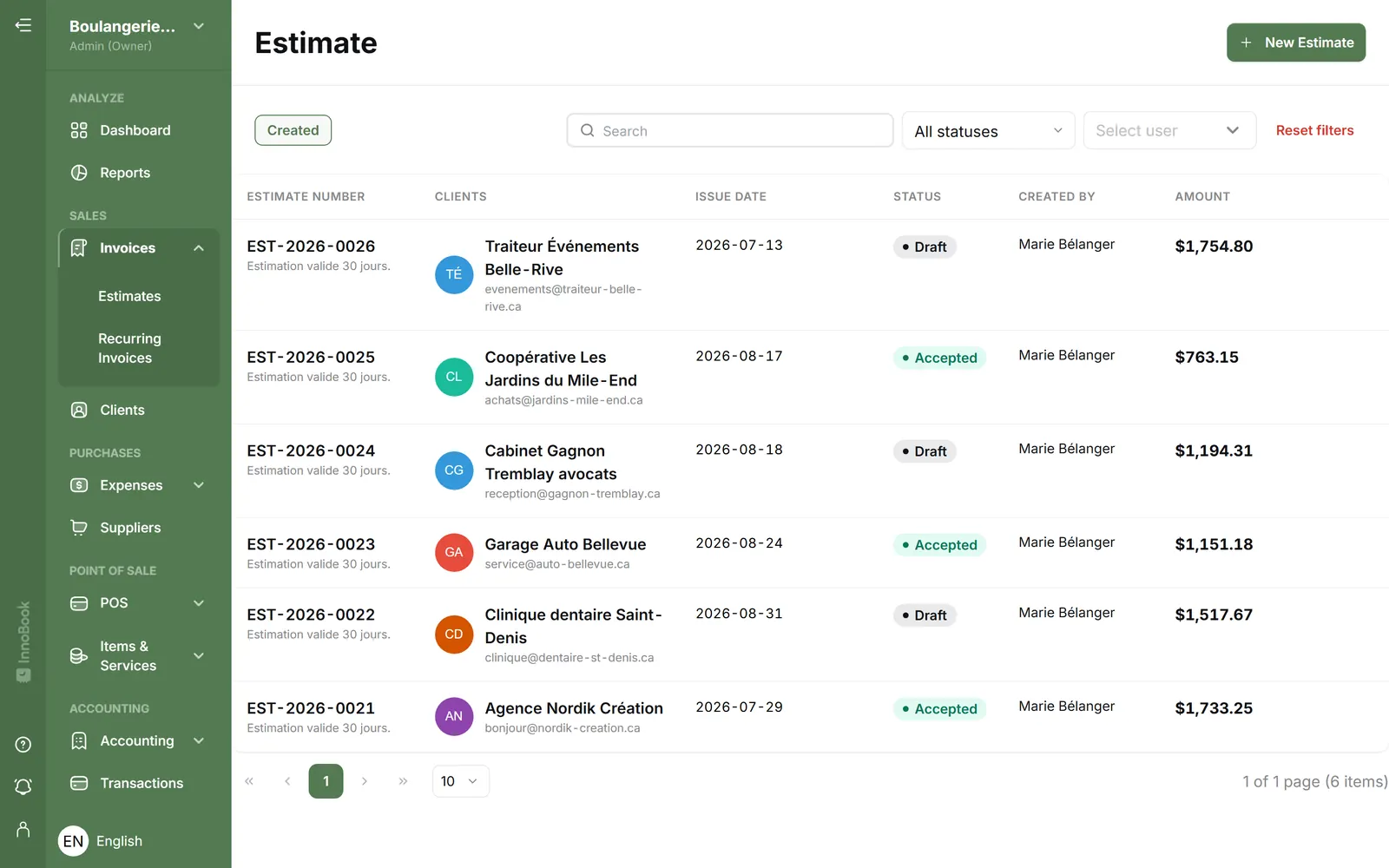
With InnoBooks, the quote is not an isolated document — it is the start of the workflow:
- ✅ Professional quotes with your logo, numbered automatically;
- ✅ GST/QST calculated and displayed correctly from the estimate stage;
- ✅ One-click conversion to invoice upon acceptance — no retyping, no discrepancies;
- ✅ Status tracking: sent, accepted, expired — you know what to follow up on;
- ✅ Per-client history: your past prices at hand to quote accurately.
Frequently asked questions about quotes
Is an accepted quote a contract?
Yes. A clear offer + an acceptance = a contract, even by email. That is exactly why the quote must be precise: it becomes your shared legal reference.
Should I charge for preparing a quote?
A simple quote is a cost of selling, so it is free. But an in-depth analysis (audit, architecture, detailed plan) is a deliverable in itself: bill it as a small mandate, creditable against the project if the quote is accepted.
The client wants to negotiate the price. What do I do?
Negotiate the scope, not the rate: “To fit that budget, we can remove X or postpone Y.” Lowering the price for the same scope devalues your work — and the client will remember it on every future mandate.
How long should a quote stay valid?
15 to 30 days is the norm. Beyond that, your availability and costs have changed. An expiry date also creates healthy decision urgency for the client.
Bottom line
A good quote sells your value, frames the project and prevents disputes — three jobs in a single document. Detail the scope, write down what is not included, show the taxes, set a validity period, follow up. And feed every new quote with the real data from the last one.
Ready to quote like a pro? Try InnoBooks for free — from quote to invoice in one click.