


You hear about mandatory e-invoicing just about everywhere: France moves to e-invoicing on September 1, 2026, the European Union is harmonizing its rules, and Australia and several U.S. states are speeding up. And in Canada? Small businesses and self-employed workers keep asking: “Do I have to issue e-invoices in 2026?” Short answer: no. Long answer: there is no official date, but it is better to be ready if a mandate is announced. This guide takes stock of the situation in Canada and Québec for 2026 and explains how to get ready in case the rules change.
What is an e-invoice, exactly?
Watch out for the trap: a PDF invoice sent by email is not an e-invoice in the regulatory sense of the term. It is simply a scanned paper invoice.
A true e-invoice is a structured document, in a machine-readable format (usually XML or UBL), that your recipient's accounting software can process automatically, with no re-entry. It typically travels over a secure network such as Peppol, which works a bit like email for invoices at the international level.
- Paper invoice: printed, mailed or handed over in person.
- PDF invoice by email: digital, but unstructured. The customer has to re-enter it or use OCR.
- E-invoice: a structured file (XML/UBL), sent automatically and fed directly into the customer's accounting.
Good to know: sending a PDF by email remains perfectly legal. But when people talk about an e-invoicing mandate, they mean the structured format, not the PDF.
Why is everyone talking about it in 2026?
The whole world is speeding up on the subject. Here are a few deadlines making headlines:
- France: an obligation to receive for all businesses and an obligation to issue for large companies and mid-sized companies (ETI) from September 1, 2026. Small and micro businesses follow on September 1, 2027.
- European Union: the VAT in the Digital Age (ViDA) directive will require structured e-invoicing for intra-EU transactions.
- Latin America: Mexico, Brazil and Chile have required e-invoicing for more than a decade.
- Asia-Pacific: Singapore, Australia and New Zealand are actively pushing Peppol adoption.
For tax authorities, the appeal is twofold: fighting VAT fraud (estimated at hundreds of billions of euros a year in the EU alone) and modernizing tax collection with real-time data.
Where exactly does Canada stand?
Let's be clear: in 2026, there is no general business-to-business (B2B) e-invoicing mandate in Canada, whether federally, in Québec or in any other province. The Canada Revenue Agency (CRA) and Revenu Québec still accept paper invoices, PDFs and structured electronic formats, as long as they contain the required information.
Here is where the federal government and Québec stand.
The federal government and the Peppol network
Canada has no Peppol Authority; the CRA is an observer at OpenPeppol, and a few private Canadian providers offer an access point.
GST/HST returns are already digital
Since 2024, filing GST/HST returns has been mandatory electronically for nearly all registrants (except certain financial institutions and most charities). So we are already well on the way to digital returns; for the invoice itself, there is no official date.
Québec and mandatory billing in restaurants
For several years, Québec has already required a form of digital billing in certain targeted sectors (restaurants, bars, paid passenger transportation) through sales recording modules (SRM) and the sales recording system (SRS).
The global timeline at a glance
| Jurisdiction | Requirement | Deadline |
|---|---|---|
| France (large companies, ETI) | Issuing e-invoices | September 1, 2026 |
| France (small and micro businesses) | Issuing e-invoices | September 1, 2027 |
| European Union (ViDA, intra-EU B2B) | Structured e-invoice | 2030–2035 (phased) |
| Canada (GST/HST, returns) | Online filing | In force since 2024 |
| Canada (GST/HST, B2B) | Issuing e-invoices | No official date: the CRA is studying e-invoicing for GST/HST between businesses. |
| Québec (restaurants, taxis) | Sales recording system (SRS) | In force |
5 reasons to switch to e-invoicing right now
Even without a mandate, adopting a structured digital approach to your invoices today can bring you benefits.
- You may get paid faster. A Billentis study puts the reduction in payment time at 10 to 30% with e-invoicing, because the customer validates and records it automatically.
- You save time. Less manual entry, fewer reminders about an invoice “never received”, less paper filing. You could win back several hours a month.
- You reduce errors. Automatic sequential numbering, automatic tax calculation, required information built in: the risk of a penalty for a non-compliant invoice goes down.
- You strengthen your image. Your business customers appreciate suppliers who fit into their systems without friction. This can be a discreet competitive advantage.
- You start from clean data. If the CRA or Revenu Québec announces a deadline, your customers, your taxes and your numbers will already be in order.
Golden rule: adopting modern invoicing software today can cost less than migrating in a hurry if a mandate is announced.
Required information on an invoice in Canada
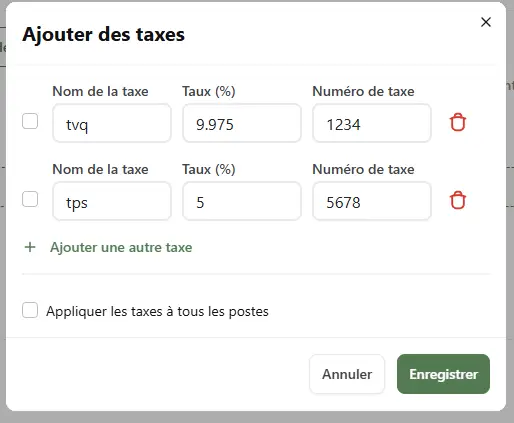
While waiting for a possible mandatory structured format, your invoices must contain a certain amount of information, whatever their medium. For any taxable sale, state that GST/HST applies, with its rate and amount, or a clear statement that the total includes it. The CRA's other requirements vary with the amount.
- For all invoices (under $100): your business name, the date, the total amount paid.
- From $100 to $499.99: add your GST/HST registration number, as well as the amount of tax (or the words “taxes included” with the applicable rates), and the status of each supply if the invoice mixes taxable and exempt items.
- $500 and over: also add the buyer's name, a description of the goods or services, and the payment terms.
In Québec, Revenu Québec requires the same types of information adapted to the QST, in addition to the QST registration number. A good invoicing software handles all of this information automatically. If you still invoice with Word or Excel, the risk of leaving something out is real.
4 myths about e-invoicing to debunk
- “It's too complicated for a small business.” False. Modern platforms hide all the technical complexity: you fill in a form and the software does the rest.
- “My customers aren't ready.” True for some. And most modern solutions automatically send a PDF alongside for customers who aren't equipped yet.
- “A PDF is already electronic.” Legally valid, yes. But not equivalent to a structured invoice. If a mandate is announced, the PDF might no longer be enough.
- “It's expensive.” On the contrary: SaaS invoicing software for a self-employed worker generally costs less than $30 a month and saves you far more in time and avoided errors.
How to get ready now in 5 steps
- Leave Word and Excel behind. Adopt real invoicing software. It is the foundation of any successful digital transition.
- Standardize your customer data. Business number, full address, email, accounting contact: make sure everything is complete and up to date. A misaddressed e-invoice is a rejected invoice.
- Digitize your expenses. Photograph your receipts, file them automatically, link them to the right tax categories. This will make your tax return and your input tax credits easier.
- Ask your provider what it has planned. No Canadian rule requires a structured invoice today. InnoBooks sends your invoices by email, as PDF; it does not produce UBL or Peppol invoices.
- Talk to your customers. Ask them whether they already require structured invoices, in which format and over which network.
What InnoBooks does for your invoices today
You don't have to wait for a mandate to enjoy the benefits of modern invoicing right now. InnoBooks is designed for Québec and Canadian small businesses and self-employed workers, with a clear and pragmatic approach:
- ✅ Compliant invoices under CRA and Revenu Québec requirements: required information and taxes calculated from the ones you set for each customer, with sequential numbering without gaps or duplicates, the practice the CRA expects of your records.
- ✅ Professional email sending with a link to the online invoice: you see when the customer has opened it.
- ✅ Expense scanning by photo to recover your input tax credits without filing anything by hand.
- ✅ Exports for your accountant: Sage 50 and QuickBooks, as an option or included depending on the plan.
- ✅ Data hosted in Canada, built-in tax compliance, no credit card required to try it.
Frequently asked questions about e-invoicing in Canada
Do I have to issue e-invoices in Canada in 2026?
No. In 2026, there is no general structured e-invoicing mandate between businesses in Canada. You can keep issuing paper invoices, PDFs or e-invoices, as long as they contain the required information from the CRA and, in Québec, from Revenu Québec.
Does a PDF sent by email count as an e-invoice?
Legally, yes: it is a perfectly valid invoice. But it is not a structured e-invoice in the sense of the new European obligations. If a mandate is announced in Canada, the PDF alone might no longer be enough.
If I sell to a European customer, am I affected by French or EU obligations?
Indirectly, yes. Your European customers may start asking you to issue invoices in a format compatible with their e-invoicing system. If a European customer requires a Peppol invoice, you have to go through a Peppol access point; InnoBooks is not one.
Is a mandate planned in Canada?
No official date: the CRA is studying e-invoicing for GST/HST between businesses. The best thing is to get ready without waiting.
What is Peppol and why does it matter?
Peppol is an international network for exchanging business documents (invoices, purchase orders, shipping notices) in a structured format. It is a standard used in several countries. Canada has no Peppol Authority; the CRA is an observer at OpenPeppol, and a few private Canadian providers offer an access point.
In short
E-invoicing is not mandatory in Canada in 2026; if a mandate is announced, it is better to be ready. Leave Excel behind, adopt modern software and standardize your customer data.
Ready to modernize your invoicing before everyone else? Try InnoBooks for free and issue your first compliant invoice in under five minutes.
Expenses: Professional Access, $10/month. QuickBooks and Sage export: $5/month option with a paid plan, or included in the Elite Plan and the Restaurant Package. First paid subscription: 15-day free trial, card required. See the plans